
The Creative Crossroads
A conversation with ITV’s creative team about Tomorrow’s possibilities
I’m grateful to Niki for inviting me in. On June 10th, I’ll open with 10–15 minutes sharing some of my thoughts — patterns I’ve been seeing recently across creative and marketing teams, the challenges they’re facing, the opportunities they’re leaning into. Then we’ll let our collective curiosity be our GPS for the conversation.
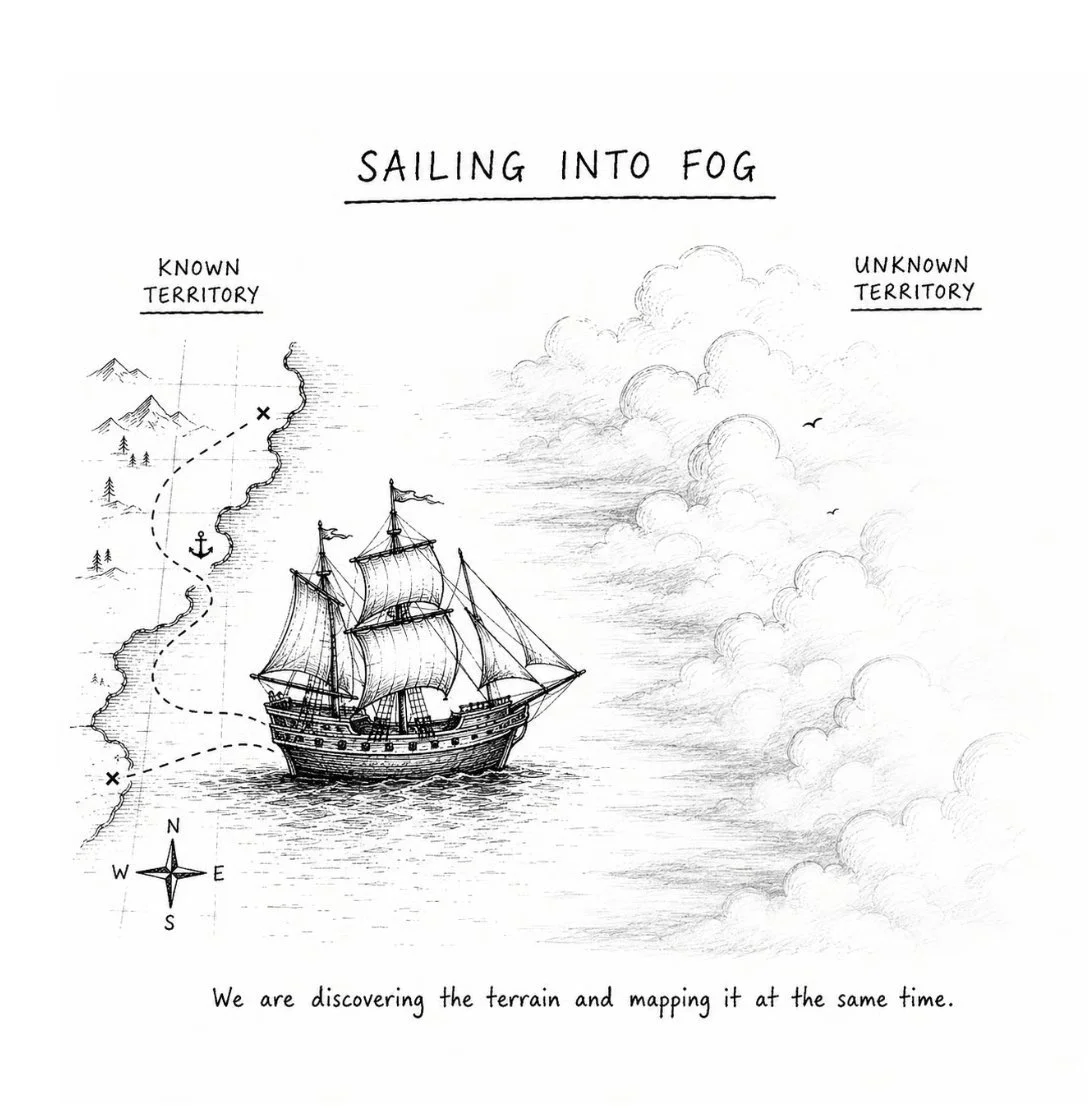
This isn’t a script for that conversation. It’s a way for you to get to know me and how I think about AI — and, I hope, to prompt your own thinking. Your own imagination. The ideas, the questions, the perspectives you want to bring into the room when we’re together. The conversation is the work. It always has been. But it matters more now than ever, because we’re all navigating terrain that doesn’t have maps yet. The old models are losing their grip. The new ones haven’t fully formed. And the only way to explore that kind of territory — to understand it, to start creating the new mental models — is together, in conversation.
Think about how you worked when you were five years old.
You had Play-Doh. You had Lego. You’d have a spark of imagination and start shaping something. If it didn’t work, you’d squish it down and start again. Pull the Lego apart, rebuild. Every day was a new game — and you made the game up. Nobody told you how to play. You just played.
Then at some point, you were told to stop. Put the blocks together this way. Shape it once. There’s a template. A best practice. A process. What was needed was output. And so the economy that built your career — what I call the execution economy — rewarded you for producing. Speed, scale, repeatability. Take a brief, interpret it, deliver something a client couldn’t make themselves. Those skills are real. They represent years of craft. They got you here.
But here’s what I believe is happening: the economy that rewarded all of that is giving way to something new. AI is better at machine work than any of us. It will always be faster, always produce more. That’s non-negotiable. And that changes the equation for everyone.
But that’s not the end of the story. That’s the beginning of a different one.
I believe AI is middleware for the human imagination. Not a tool that replaces creative people — a layer that takes over the machine work so we can get back to the human work. The work of imagination, taste, judgment, origination. The work most of you got into this profession to do before the execution economy trained it out of you.
▶ Watch: AI Big Bang Moment — Middleware for the Human Imagination
And here’s the economic reality underneath: all of human history has run on one cycle — we innovate, then we copy, then we commoditize. Pre-AI, that cycle played out slowly enough that you could build a career, a team, an organization around a single advantage and harvest it for years. But AI compresses that cycle to the point where today’s advantage becomes tomorrow’s table stakes. The only durable advantage left is the ability to keep originating the next one. That’s not a philosophical argument. It’s an economic one.
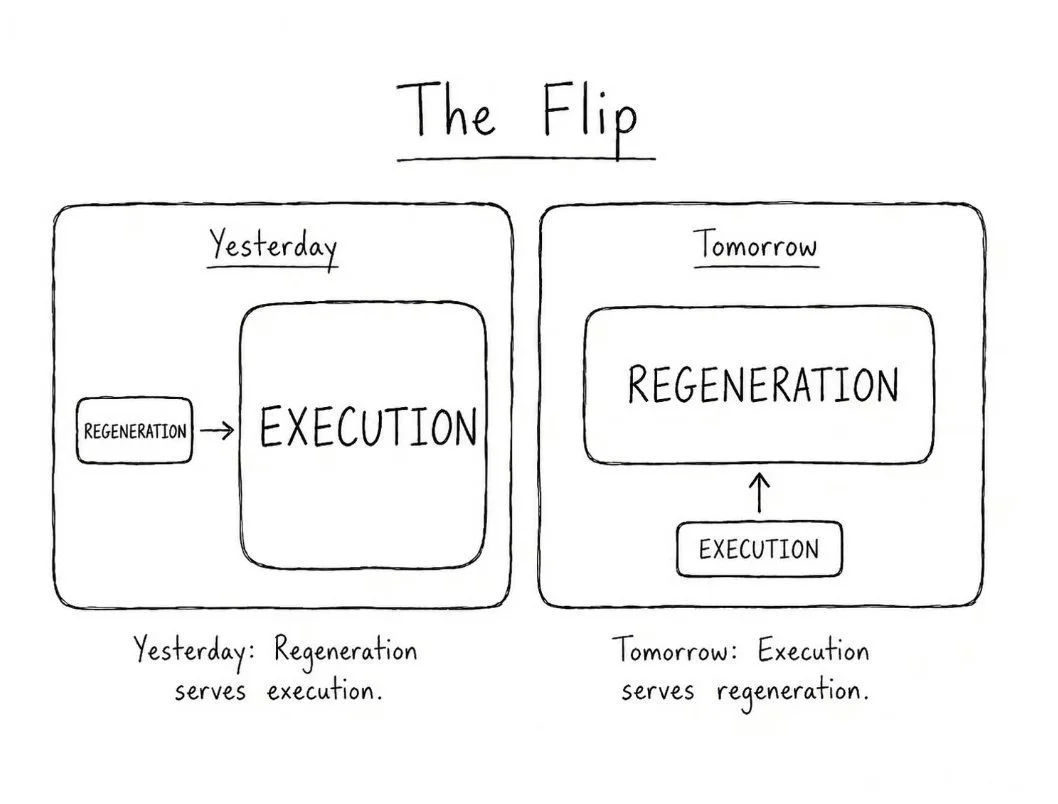
The regenerative economy — what comes after the execution economy — doesn’t reward you for doing more of yesterday faster. It rewards you for imagining what didn’t exist before. For having the judgment to know the difference between something that functions and something that resonates. For bringing the Play-Doh and the Lego back to work.
▶ Watch: Incentivize Playfulness and Experimentation for Real Results
I have a very personal reason for seeing it this way.
I have a condition called Charcot-Marie-Tooth — a degenerative motor neurological condition. It’s taken away physical capabilities I used to take for granted. Walking upstairs. Running. Tying my shoelaces. When it first set in, what I felt wasn’t frustration. It was a loss of identity. The things I could do were part of who I thought I was, and as they disappeared, I felt like I was becoming less valuable. Less me.
I hear the same thing from professionals of all stripes when AI enters their world. Not just “I’m worried about my job.” Something deeper. Something primal. If the machine can do the work I’ve spent my career mastering, then who am I?
What I discovered is that losing the old capabilities didn’t make me less. It became a chisel — something that carved away what was never really me to begin with and revealed everything underneath. Creativity, curiosity, empathy, dimensions of myself I never would have found if the physical abilities had stayed intact. My disability is the single best thing that has ever happened to me. I say that with complete sincerity.
▶ Watch: AI and a Loss of Identity
I think AI is that same chisel for creative work. It’s stripping away the execution layer — the part that was always more machine than human. And what’s left is everything that can’t be commoditized. Your taste. Your judgment. Your ability to originate. Your understanding of what makes something matter to another human being.
So here’s the fork I see.
In one direction, AI becomes the fastest production line ever built. Everything becomes machine work — including you. Output goes up. The work is competent. Nobody feels anything about it. The content is fine. It just doesn’t matter.
In the other direction, the machines do the machine work. All of it. And you go back to the human work. You don’t become less. You become more of who you actually are.
Let machines machine so humans can human.
That second path doesn’t happen by default. And it doesn’t happen because leadership decides it or because a strategy deck says so. It happens because of what individual creative people — people like you — choose to do with this moment. But it also happens because the economics demand it. When every competitor has the same AI superpowers, when execution is commoditized overnight, the only thing left that creates differentiation is the human capacity to imagine, to originate, to see what the machines can’t. That’s not optimism. That’s the math.
That’s what I want to explore on June 10th. Not which tools to adopt. Not what skills will matter moving forward — though we’ll get into that. The harder, more interesting questions: What does it actually look like to choose the human work? What are the tensions you’ll have to navigate? What are the trade-offs? What are the harsh realities — including the possibility that some of the work being done right now isn’t creative work at all, it’s machine work with a creative title? And one I’ve found particularly valuable to have on purpose: how do people at different stages of their careers see AI differently? That conversation surfaces hidden challenges and hidden opportunities. And what becomes possible if you’re honest about all of it?
The conversation is the work.
— Nish
Nish Patel operates at the intersection of AI’s blank canvas of possibility and the infinite imagination of humans. He works with leaders at that intersection, helping them navigate from yesterday’s execution economy to tomorrow’s regenerative one.
He’s the creator of Tomorrow With Nish — an executive and leadership advisory firm, newsletter, podcast, and fireside conversation series — and hosts Tomorrow’s Table, a series of curated dinners for leaders navigating what’s next, in cities across North America and Europe. He’s facilitated fireside conversations with creative and leadership teams at organizations across industries. He’s been talking about AI as middleware for the human imagination since 2022, and through his AI studio Brilliant With AI, he builds the product experiences that make that core philosophy a reality.